We all use electronic devices every day, but few people know what actually happens inside a phone or a charger. You don’t need to be an engineer: with four basic concepts you can already understand why a charger “isn’t powerful enough”, why a battery gets hot, or what it means when a board has a short circuit.
This guide explains those concepts with everyday examples. It is the same vocabulary we use when diagnosing a fault at the bench.
The water analogy
The easiest way to understand electricity is to picture a pipe full of water:
- Voltage is the water pressure.
- Current is how much water flows through the pipe every second.
- Resistance is how narrow the pipe is.
More pressure, more water flows. A narrower pipe, less water flows. That relationship is, essentially, the foundation of all electronics.
Voltage (V): the “push”
Voltage is measured in volts (V). It is the difference in electrical “pressure” between two points — what pushes electrons to move.
Some reference values:
- An AA battery: 1.5 V.
- A phone battery: about 3.7–3.85 V (up to ~4.4 V when fully charged).
- A standard USB port: 5 V. With fast charging it can go up to 9 V, 12 V or even 20 V for laptops.
- A wall socket in Europe: 230 V AC. This is dangerous.
An important detail: voltage is always measured between two points. When we say a battery “has 3.8 V” we mean there are 3.8 V between its positive and negative terminals.
Current (A): how much electricity flows
Current is measured in amperes (A) and is the amount of electrical charge passing a point every second. In small electronics we often use milliamps (mA): 1 A = 1,000 mA.
Examples:
- A small LED draws about 10–20 mA.
- A charging phone can draw 1 to 3 A (or more with fast charging).
- A phone on standby with the screen off draws very little: tens of milliamps.
When we connect a board to a bench power supply, the first thing we look at is how much current it draws. If a board that is off draws a lot, something is shorted. If it draws nothing, something isn’t reaching it or isn’t starting up. That number tells you a lot about the fault.
Resistance (Ω): what slows current down
Resistance is measured in ohms (Ω) and is how much a material or component opposes the flow of current.
- A copper wire has very low resistance: current flows easily.
- Plastic or air has extremely high resistance: they don’t conduct (they are insulators).
- Resistors are components designed to have a specific value, to control how much current flows somewhere.
Ohm’s law: the formula that ties it together
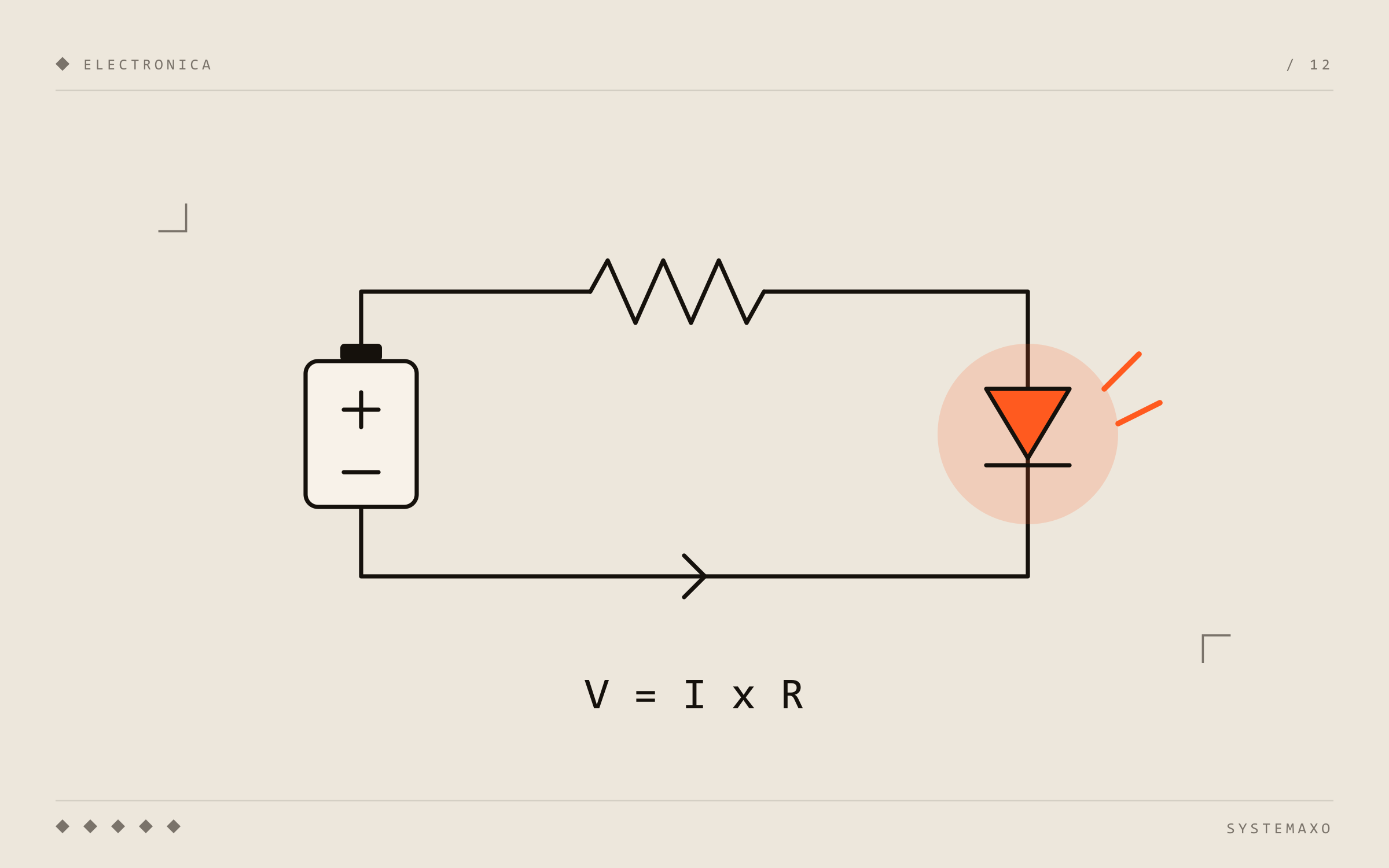
The relationship between the three is Ohm’s law:
V = I × R (voltage = current × resistance)
Or, rearranged: I = V / R.
And to find resistance: R = V / I.
An easy way to remember it is the Ohm’s law triangle: V on top, I and R at the bottom. Cover what you want to calculate and what’s left gives you the operation: V = I × R, I = V / R, R = V / I.
Three examples:
- Finding current: apply 5 V across a 100 Ω resistor and 5 / 100 = 0.05 A flows — that is, 50 mA.
- Finding voltage: if 0.02 A (20 mA) flows through a 220 Ω resistor, there are 0.02 × 220 = 4.4 V across it.
- Sizing a resistor for an LED: with a 5 V supply and an LED that needs about 2 V at 20 mA, the resistor takes the remaining 3 V: R = 3 / 0.02 = 150 Ω.
Why does this matter in real life? Look at what happens when resistance gets close to zero: current shoots up. That is exactly a short circuit.
Power (W): the energy being used
Power is measured in watts (W) and is calculated as:
P = V × I (power = voltage × current)
That is why a “5 V, 2 A” charger is a 10 W charger, and a “9 V, 3 A” fast charger delivers 27 W. USB‑C laptop chargers usually deliver 45, 65 or 100 W by raising the voltage up to 20 V.
Power is also heat. Every component that uses energy warms up to some extent. When a shorted component lets a lot of current through, it gets very hot — which is exactly what we use at the bench to find it with a thermal camera.
Direct current and alternating current
- Direct current (DC): flows in one direction only. Batteries and all the internal circuits of phones, tablets and computers use DC.
- Alternating current (AC): changes direction many times per second (50 times in Europe). This is what comes out of the wall.
Your charger is basically a machine that turns 230 V AC from the socket into 5–20 V DC that the device can use.
Short circuit and open circuit
These are the two “basic” faults of any circuit:
- Short circuit: current finds a path with almost no resistance, usually straight to ground (negative). It draws a lot of current, heats up and usually stops the device from turning on. In phones, the typical culprit is a tiny capacitor that has cracked internally, often after a drop or liquid damage.
- Open circuit: the path is broken and current can’t flow. For example a broken trace on the board, a cracked solder joint or a blown fuse.
Much of board diagnosis is finding one of these two problems: something that lets too much current through, or something that lets none through.
Ground (GND)
In almost every schematic you’ll see “GND” or ground. It is the circuit’s 0 V reference point — the point all voltages are measured against. On a phone board, practically all metal shielding and large copper areas are connected to ground.
The multimeter: the essential tool
If you’re interested in electronics, the first instrument to get is a multimeter. With it you can measure:
- Voltage: to check whether a battery is charged or whether power reaches a point.
- Resistance: to see whether something is shorted (near 0 Ω to ground) or open.
- Continuity: the mode that beeps when two points are connected. Very useful for checking cables and traces.
- Current: with more care, because the meter has to be placed in series with the circuit.
A safety tip: practise with batteries and low-voltage circuits. Don’t open or probe devices connected to mains power unless you know exactly what you’re doing, and never puncture or short a lithium battery — they can catch fire.
Summary
| Quantity | What it is | Unit |
|---|---|---|
| Voltage | The electrical “push” between two points | Volts (V) |
| Current | How much electricity flows per second | Amperes (A) |
| Resistance | What opposes the flow of current | Ohms (Ω) |
| Power | Energy used per second (and heat) | Watts (W) |
With these concepts you’re ready for the next step: the basic electronic components found inside any device and how each one fails.
Got a device that isn’t working?
If your phone, tablet or computer won’t turn on, won’t charge or overheats, Systemaxo offers board-level phone repair and computer and laptop repair in Carcaixent and La Ribera (Valencia). We explain what failed and give you a quote before repairing.