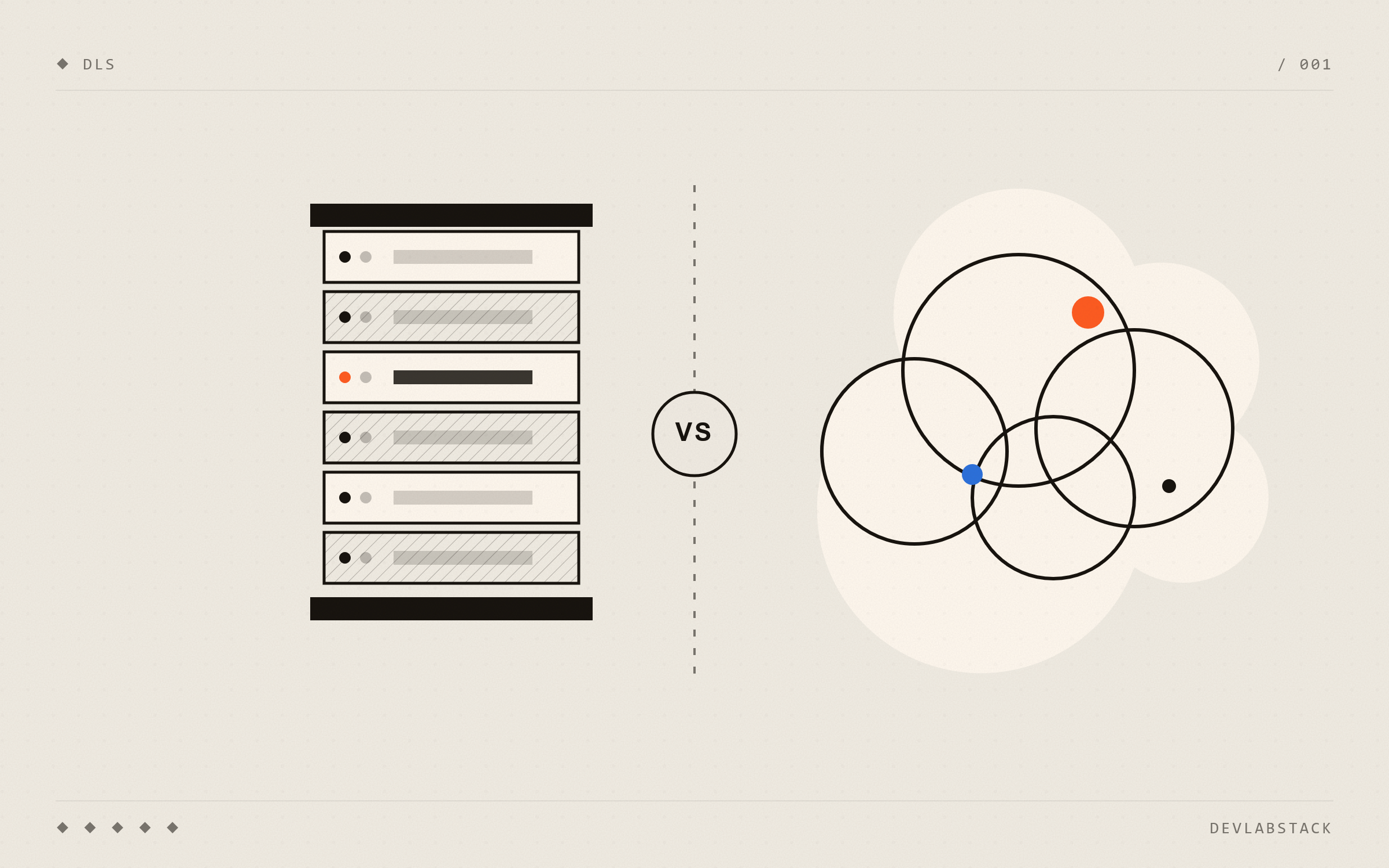
One of the most important decisions when launching or scaling an application is where it’s going to live. The answer is not universal: it depends on the type of business, data volume, regulatory compliance requirements and the team’s technical capacity. This guide analyses both options with concrete criteria so you can make the right decision for your case.
What Each Option Actually Means
On-premise (own server) Your company buys or rents physical hardware — either at your premises or in a data centre (colocation) — and manages all the infrastructure: hardware, operating system, networking, security and backups.
Public cloud You contract compute, storage and networking resources from providers like AWS, Google Cloud Platform or Microsoft Azure. You pay per use and the provider manages the underlying hardware.
Hybrid cloud A combination of both: sensitive workloads on-premise, the rest in the cloud. This is the model most companies adopt as they mature.
Cost Analysis: The Hourly Price Trap
The most common argument for cloud is “you don’t have to buy servers.” But the real cost analysis is more nuanced.
On-premise cost
Dedicated server (example):
- Initial hardware:          €8,000 – €25,000 (5-year lifespan)
- Colocation (rack/month):   €200   – €500/month
- Electricity and network:   €100   – €300/month
- Maintenance and mgmt:      €500   – €1,500/month (staff or provider)

Approximate monthly total:   €700 – €2,300/month
Cloud cost (AWS example for a production app)
EC2 m6i.xlarge instance (4 vCPU, 16GB RAM):
- On-demand:        $0.192/hour → ~$140/month
- Reserved 1 year:  $0.122/hour → ~$89/month

RDS PostgreSQL db.t3.medium:
- On-demand:        ~$80/month

S3 Storage (500GB):          ~$11.50/month
Outbound data transfer:      ~$45/month (500GB)
Load Balancer:               ~$20/month

Estimated total: ~$340/month for a medium-sized app
The trap: cloud scales up easily but so does the bill. A poorly configured app with traffic spikes can multiply the monthly cost by 5 in a matter of days. On-premise has predictable fixed costs.
The break-even point is usually between 3 and 5 years: cloud is cheaper for variable or growing workloads; on-premise wins for stable, predictable workloads long term.
Data Control and Regulatory Compliance
This factor is frequently decisive in regulated sectors.
GDPR and data in Europe
GDPR requires that personal data of European citizens is stored and processed with adequate guarantees. The three major cloud providers have regions in Europe (AWS Frankfurt/Madrid, GCP Madrid, Azure Madrid) and offer GDPR-compatible Data Processing Agreements (DPA).
However, some sectors have stricter requirements:
Sectors where on-premise remains common:
  - Banking and finance: sensitive financial data
  - Healthcare: medical records (ENS, HIPAA if US clients)
  - Public administration: National Security Scheme (ENS)
  - Defence industry: classified data
Data sovereignty
Some companies simply don’t want their data to leave their physical control, regardless of legal compliance. For these cases, on-premise or private cloud (OpenStack, VMware) is the only real option.
Performance and Latency
When on-premise wins on performance
- Access to local massive data: if your application processes large volumes of data already in your premises (industrial machinery, SCADA systems, legacy databases), moving everything to cloud can create unacceptable latencies.
- Critical low-latency applications: trading systems, real-time industrial control or medical applications where every millisecond counts.
When cloud wins on performance
- Geographic distribution: integrated CDNs and global regions allow serving content from the node closest to the end user.
- Automatic scaling: absorbing traffic spikes without prior planning — a marketing campaign that multiplies traffic by 10 in hours.
# Auto-scaling example in AWS (not possible on-premise without prior investment)
aws autoscaling create-auto-scaling-group \
  --auto-scaling-group-name my-app-asg \
  --min-size 2 \
  --max-size 20 \
  --desired-capacity 2 \
  --target-group-arns arn:aws:elasticloadbalancing:...
Availability and Disaster Recovery
| Scenario | On-premise | Cloud |
|---|---|---|
| Hardware failure | Resolution time: hours/days | Automatic failover: seconds |
| Backup and recovery | Requires own design and maintenance | Managed (S3, RDS snapshots) |
| Multi-region | Very expensive | Standard in all three major providers |
| Guaranteed SLA | Depends on colocation provider | 99.9% – 99.99% with compensation |
For most business applications, cloud offers higher availability with less operational effort. On-premise can reach the same levels but requires significant investment in redundancy.
Decision Table
| Criterion | Best option |
|---|---|
| Predictable, stable workload | On-premise |
| Variable or rapidly growing workload | Cloud |
| Small technical team | Cloud |
| Highly sensitive or regulated data | On-premise / Private cloud |
| Geographic distribution of users | Cloud |
| Limited initial budget | Cloud |
| Full hardware control | On-premise |
| Integration with local legacy systems | On-premise or hybrid |
| Fast time-to-market | Cloud |
The Practical Option for Most: Hybrid Cloud
In practice, most mid-sized companies end up with a hybrid model:
- Web apps and APIs: cloud (auto-scaling, less maintenance)
- Databases with sensitive data: on-premise or private cloud
- Backups and archiving: cloud (S3 Glacier is extremely cheap)
- Critical legacy systems: on-premise until they can be migrated
# Example: VPN between on-premise and AWS (hybrid architecture)
resource "aws_vpn_connection" "main" {
  vpn_gateway_id      = aws_vpn_gateway.main.id
  customer_gateway_id = aws_customer_gateway.onpremise.id
  type                = "ipsec.1"
  static_routes_only  = true
}

resource "aws_vpn_connection_route" "onpremise" {
  vpn_connection_id      = aws_vpn_connection.main.id
  destination_cidr_block = "192.168.0.0/16"  # On-premise network
}
Conclusion
There is no universally correct answer. Cloud wins on flexibility, speed of deployment and operational management. On-premise wins on control, predictable long-term costs and strict compliance requirements.
The question isn’t “cloud or own server?” but “which workloads work better in each environment for my specific case?”
If you’re evaluating infrastructure architecture for your project and need an independent technical opinion, tell us your case.